
Free Freight Class Calculator | Get Class, Density and Volume in Seconds
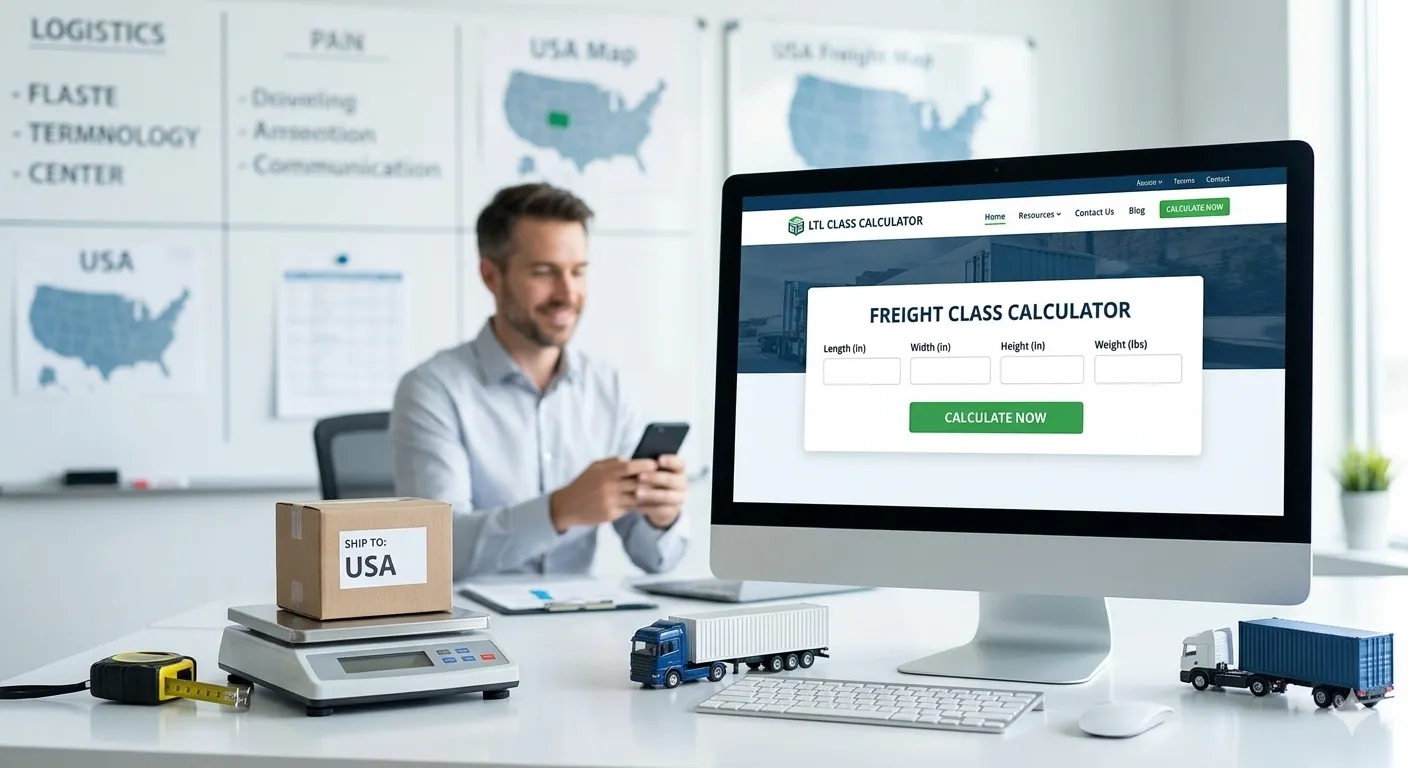
Enter your shipment dimensions and weight to see an estimated class, pounds per cubic foot (PCF), and total cubic feet. Our freight class calculator gives US shippers three useful measurements from four inputs. Use the results to prepare shipment details and check your numbers before requesting an LTL quote.
You do not need an account or a freight quote to use the tool. Its class result is a density based estimate, not an official commodity classification. Your carrier may assign a different class under the applicable NMFC rules.
How Do You Calculate Freight Class for LTL Shipping?
Start with the size and total weight of the shipment as it will travel. The calculator determines volume, uses that volume to find density, and shows a suggested class based on its configured density chart. You can complete the calculation in three steps.
Enter Your Shipment Dimensions and Weight
Measure length, width, and height in inches. Enter the total weight in pounds, including pallets and packaging. Use the farthest outside points of the packed shipment rather than the dimensions printed on a product box.
Review Your Estimated Class, Density and Volume
Select Calculate Results. Read the freight class estimate first, then check density in PCF and volume in cubic feet. If a number looks wrong, check the dimensions and weight you entered. This tool accepts one set of dimensions and one total weight for each calculation.
Check the Class Before Booking
Find the correct NMFC item for the goods you are shipping. A density figure alone does not identify a product. Give the carrier an accurate commodity description and ask which classification applies. This matters most when goods need special handling, are unusually shaped, or have a specific classification rule.
Freight Density Calculator: Find Pounds per Cubic Foot
Freight density measures weight relative to the space a shipment takes up. It is shown in pounds per cubic foot, or PCF. Dense freight places more weight into the same amount of space than lighter, bulkier freight.
How Do You Calculate Freight Density?
First calculate cubic feet. Then divide the total shipping weight by that volume.
Density (PCF) = Total weight in pounds ÷ Total volume in cubic feet
If a packed pallet weighs 500 pounds and occupies 53.33 cubic feet, its density is about 9.38 PCF. The weight has not changed, but a larger box or taller pallet would increase volume and lower the calculated density.
Check a Realistic Pallet Example
Suppose a pallet measures 48 inches long, 40 inches wide, and 48 inches high. Its packed weight is 500 pounds.
- Cubic inches: 48 × 40 × 48 = 92,160.
- Cubic feet: 92,160 ÷ 1,728 = 53.33.
- Density: 500 ÷ 53.33 = about 9.38 PCF.
Under the standard 13-level NMFC density scale, 9.38 PCF falls within the range associated with class 100. That association applies only when the relevant NMFC item uses that scale. It does not confirm the class of an unidentified product.
Calculate Freight Volume in Cubic Feet
Volume is the space occupied by your packed shipment. It helps explain the density result and gives you a number you may need when recording pallet measurements or comparing shipment sizes. Volume is not a shipping price.
How Do You Calculate Cubic Feet for Shipping?
Cubic feet = Length × Width × Height in inches ÷ 1,728
There are 1,728 cubic inches in one cubic foot. For a shipment measuring 48 by 40 by 48 inches, the volume is 53.33 cubic feet. A shipping cubic feet calculator follows this same conversion for a rectangular shipment.
How Should You Measure a Palletized Shipment?
Measure the finished pallet after the freight has been packed and secured. Include the pallet’s height and any cartons, wrap, or braces that stick out. Measure from the outermost points. Do not use a standard pallet height if your actual load is taller.
The tool uses a rectangular space calculation. Irregular items may require carrier specific measurement rules. If you have several pallets with different sizes, calculate each handling unit separately rather than entering one set of dimensions for all of them. Keep the individual measurements with your shipment records so you can check them later.
How Is LTL Freight Class Determined?
Freight class is a numbered classification used in less than truckload shipping. The National Motor Freight Classification (NMFC) lists commodity descriptions, items, and assigned classes. The system includes 18 class numbers, from 50 to 500. A class number is different from the NMFC item number used to identify the goods.
What Factors Determine Freight Class?
The National Motor Freight Traffic Association (NMFTA) identifies four transportation characteristics: density, handling, stowability, and liability. Density is the weight for a given amount of space. Handling covers the work or equipment needed to move an item. Stowability considers how freight fits with other cargo. Liability concerns risk, including damage or other loss.
A shipment’s assigned class depends on the wording of its applicable NMFC item and any related provisions. Two products with identical density can have different classes. Consult NMFTA’s classification guidance for the official framework.
Understand the Current Freight Class and Density Chart
The 2025 NMFC changes introduced a standard 13-level density scale for many affected commodities. Those 13 ranges should not be confused with the 18 freight class numbers used in the wider classification system.
For example, the current standard scale associates 6 to less than 8 PCF with class 125; 8 to less than 10 PCF with class 100; and 10 to less than 12 PCF with class 92.5. These examples are useful for understanding a density range, but not every commodity follows that chart. Read the NMFTA density explanation before using a chart to assign a shipment’s actual class.
What Is an NMFC Code?
An NMFC item number points to a commodity entry in the classification. Freight class is the class assigned under that entry’s rules. To confirm a shipment, identify what the goods are made of, how they are packaged, and which item applies. Use the current NMFC reference or ask your carrier for classification help. This calculator does not search NMFC item numbers.
Common Freight Class Calculation Mistakes
Simple measurement errors can move a shipment into a different density range. Checking inputs may prevent confusion when you compare your estimate with a carrier’s figures.
Measuring the Product Instead of the Packed Load
A product might be 42 inches tall, but the packed pallet may be 48 inches tall. Entering 42 inches leaves out space the shipment actually occupies. Check the outside dimensions after packing.
Leaving Out Pallet or Packaging Weight
Use the weight of everything being shipped together. A manufacturer’s product weight may exclude the pallet, cartons, and protective materials. When possible, weigh the finished shipment rather than adding rough estimates.
Treating an Estimate as a Guaranteed Class
A carrier may inspect, measure, weigh, or reclassify freight using the correct commodity rules and its terms. The tool does not guarantee rates, prevent added charges, or replace NMFC lookup. Use it to check figures, not to certify the shipment.
Freight Class Chart: Density to Class (NMFC 13-Tier Scale)
Use the following reference chart or NMFC Freight Class list to estimate your freight class based on pounds per cubic foot (PCF). Note: stowability, handling, and liability also affect the final NMFC classification.
| Density (pcf) | Freight Class |
|---|---|
| 50 and above | 50 |
| 35 to under 50 | 55 |
| 30 to under 35 | 60 |
| 22.5 to under 30 | 65 |
| 15 to under 22.5 | 70 |
| 12 to under 15 | 85 |
| 10 to under 12 | 92.5 |
| 8 to under 10 | 100 |
| 6 to under 8 | 125 |
| 4 to under 6 | 175 |
| 2 to under 4 | 250 |
| 1 to under 2 | 300 |
| Under 1 | 400 |
Download the freight class chart (PDF)
How to read this chart
Find your shipment’s density in the left column. The number next to it is the estimated freight class. Not sure of your density? The calculator at the top of this page works it out for you.
This chart follows NMFC Docket 2025-1, which took effect on July 19, 2025. It applies to items that are classified by density alone. Items with special handling, stowability, or liability rules can have fixed classes, so always confirm the class with your carrier. Last reviewed: October 2026.
The 18 freight class numbers are 50, 55, 60, 65, 70, 77.5, 85, 92.5, 100, 110, 125, 150, 175, 200, 250, 300, 400, and 500. The density chart above uses 13 of them. The other five (77.5, 110, 150, 200, and 500) are not part of this density chart, but they still appear in the NMFC for other items.
How to use this NMFC freight class calculator to calculate freight class
Kindly feel free to contact us for any query, or read about us.
Frequently Asked Questions
How Do I Find My Shipment’s Freight Class?
Enter the packed dimensions and total weight for a density based estimate. Then identify the applicable NMFC item and confirm its class with the carrier or an authorized classification source.
Is Freight Class Based Only on Density?
No. Many commodities use density rules, but handling, stowability, liability, and commodity specific provisions may change the class. Density alone cannot identify every product’s correct class.
Can I Use This Calculator for Palletized Freight?
Yes. Enter the outer dimensions of one packed pallet and its total weight. For multiple pallets of different sizes or products, check each one and confirm how the carrier classifies the complete shipment.
Does Freight Class Tell Me What Shipping Will Cost?
No. The final LTL rate can depend on weight, distance, carrier pricing, pickup and delivery services, and other charges. You need a carrier quote to know the shipping price.
Explore More LTL Freight Calculation Guides
Need help measuring a pallet or interpreting PCF? Visit our Knowledge Center for practical guides about pallet density and related shipping measurements. Review the examples before preparing your next shipment.
Before requesting a quote, confirm your dimensions, weight, commodity description, and NMFC item. Return to the freight class calculator above whenever you need to check the numbers. The tool is free to use, and the carrier remains the source for the final shipment classification.